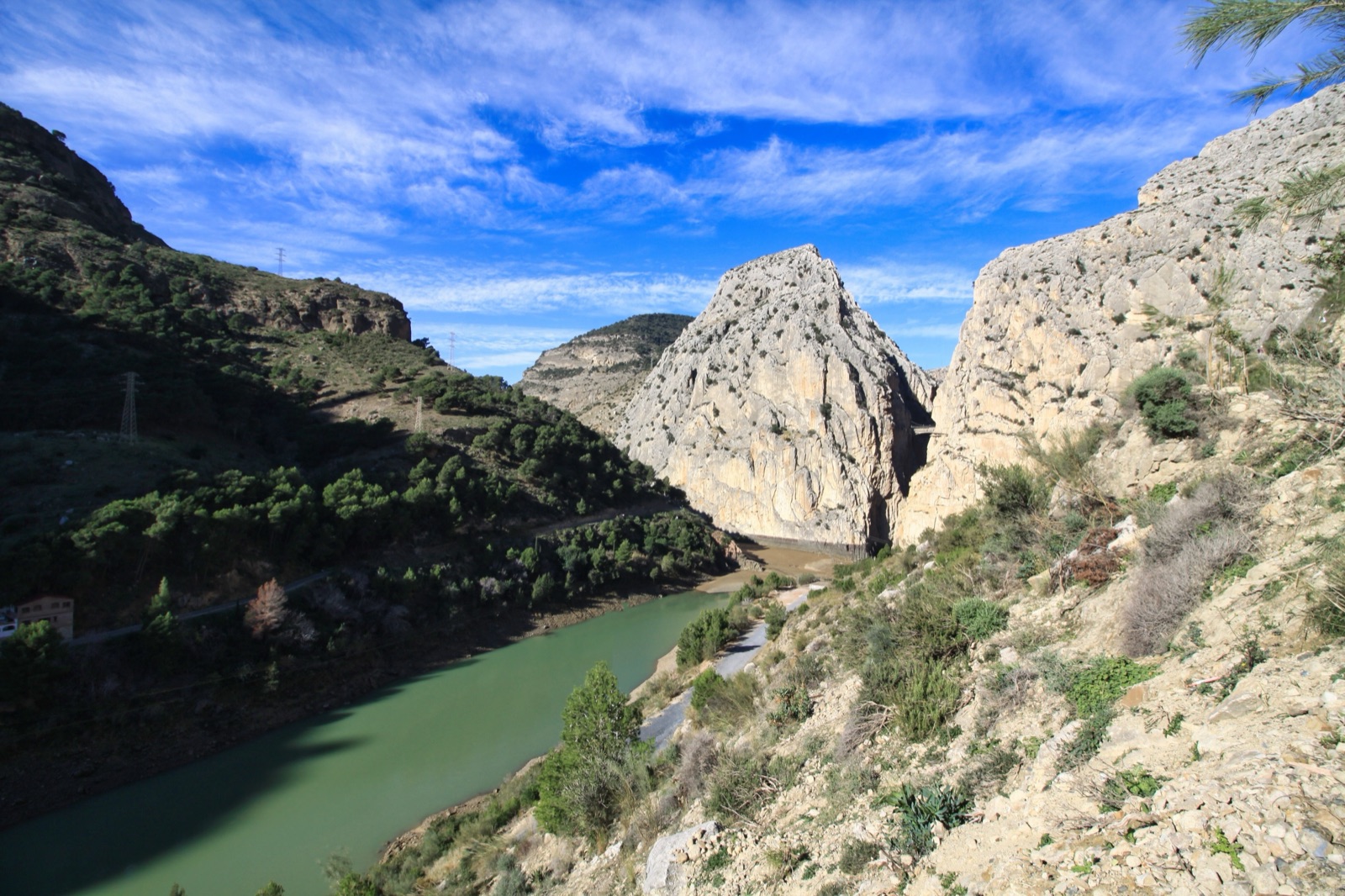
Is the Caminito del Rey Dangerous? Safety, Rules, Fear of Heights and History
No, not in the way its reputation suggests. The Caminito del Rey you can walk today is a rebuilt walkway with continuous railings and mesh, reopened in March 2015, with controlled entry, compulsory helmets, staff on the route and closures when the weather turns. The “world’s most dangerous path” label belongs to the old, crumbling concrete path that still hangs below the new one, which was closed after fatal accidents in 1999 and 2000. The operator is candid that some risk remains: the walk is in a natural gorge, small rockfalls can happen, and much of it is high above the river. In its own words, visitors are not risking their lives, but the place may shock some people. For most reasonably fit visitors the real hazards are heat, a stumble on steps, and vertigo, not falling off.
This guide explains what made the old path deadly, what changed, the risks that remain and how they are managed, the rules you must follow, and what to expect if you are nervous of heights.
Old path and new walkway compared
| Old path (built 1901 to 1905) | Today’s walkway (since 2015) | |
|---|---|---|
| Width | Barely 1 m | No more than a metre and a half on most boardwalks |
| Protection | Broken railings, missing sections | Railings and mesh along the whole boardwalk |
| Height above the river | Around 100 m | The same line, just above the old path |
| Access | Open, then closed and partly demolished | Timed tickets, ID check, groups every 10 minutes |
| Safety kit | None | Helmet compulsory for the whole route |
| Staff | None | Control booths, patrols, cameras |
| Weather | Nobody to close it | Closed for strong wind, heavy rain and extreme heat |
Why the old path was so dangerous
The original Caminito del Rey was built between 1901 and 1905 as a service path for the El Chorro hydroelectric scheme, fixed to the walls of the Gaitanes gorge about 100 m above the river. It was about 3 km long and barely 1 m wide. For decades it was simply part of local life: families living in the gorge used it to reach school, the shops and the railway, and it had electric lighting so people could use it at night. King Alfonso XIII walked it in 1921, and it has carried his name ever since.
Over time it fell apart: weather and human damage left the path, in the operator’s words, in a deplorable state, until using it became impossible. At the same time the path’s danger, and the climbing in the gorge, drew climbers and thrill-seekers. The operator’s own history says plainly that this caused numerous accidents over the years, some of them fatal.
In 1999 and 2000, fatal accidents killed four people. The worst was reported by El País on 12 August 2000: three young men aged 20 to 25 died after a fall of about 120 m in the gorge. They had been sliding down an old cable that had been left strung across it for decades, and one of its anchors gave way. After those deaths the Junta de Andalucía stopped access and demolished the start of the path to keep people off it.
Near the hanging bridge today there are plaques for people who died in accidents in the gorge before the restoration, placed there at their families’ request. It is a quiet spot; most walkers pass it without stopping, and that is fine, but it is worth knowing what they are.
What changed in 2015
The Diputación de Málaga began the full restoration after February 2014, working with the councils of Ardales, Álora and Antequera and the regional government. The walk reopened on 28 March 2015, and the whole build took less than a year. Instead of repairing the old path, a new wooden boardwalk was fixed above it; in places it runs just 1 m over the old concrete, so you can see exactly what earlier walkers were on.
The new structure was designed to be light but strong: mesh panels and steel cables between you and the gorge. Before it opened, the hanging bridge was load-tested with up to 50,000 kg. In June 2026 a second, 110 m hanging bridge was added near the exit to take visitors away from the most rockfall-prone part of the descent (more on that below).
Going onto the old path, or walking through the railway tunnels to reach the gorge, is still prohibited, and the operator’s history page says it carries a 6,000 euro fine.
How the walk is managed today
The safety system is more extensive than most visitors notice. From the operator’s own descriptions:
- Daily checks. The installations are inspected at the start of every day and again throughout it.
- Controlled entry. Groups enter every 10 minutes, so the boardwalks never fill up.
- Helmets. Compulsory for the whole route, handed out at the north booth and returned at El Chorro.
- Staff and cameras. Staff patrol the route and cameras cover it, backed by a private security service.
- Medical cover. Seven defibrillators cover the route, four at fixed points and three carried by staff.
- Emergency access. There are three emergency helicopter landing areas along the gorge.
- Position markers. Handrail clips carry a code such as 102N or 54S, so you can tell staff or the emergency services exactly where you are.
- Weather sensors. Two wind sensors in the main gorges and a rock-temperature sensor feed closure decisions, with advice from AEMET, Spain’s state weather agency.
- Rest areas. Spaced roughly every 200 m, to limit the effects of heat and effort.
- Insurance. Every ticket includes civil liability insurance from the boardwalk entrance to the exit, unless an accident is caused by breaking the rules.
The real risks today
Rockfall
This is the risk the operator takes most seriously, and the reason for the helmets. The gorge walls are high and fractured, and small stones do come down, especially after rain or in wind. Small orange marks (2x6 cm) on the handrails flag places where the risk is higher: do not stop there, just keep walking. If you hear stones moving above you, stand against the wall and move away. On days when rocks are falling in the Valle del Hoyo, staff can divert visitors through a restored 300 m section of old canal tunnel instead of the open path.
A University of Granada study found a high rockfall risk at the end of the trail and on the start of the old path down. That is why the new bridge was built: opened on 10 June 2026, it is 110 m long, at most 50 m up and 1.2 m wide, takes up to 30 people at once, and saves almost a kilometre of steep descent. The old final stretch is still open for those who prefer it.
Heat
For most visitors this is the bigger danger. Much of the route is exposed rock with little shade, the walk takes three to four hours, and inland Málaga gets very hot. The operator closes the walk when AEMET issues an orange heat warning: on 11 July 2023 it shut for the day with highs of 41 °C forecast in Ardales, Álora and Antequera, and the next day opened only from 8.00 to 12.00. On another occasion it suspended visits for a Thursday and Friday in late July with forecasts of up to 44 °C. Carry at least 1.5 litres of water each, and in summer choose an early slot. The best time to visit guide covers the hot months in detail.
Wind and rain
Strong wind is the most common reason for a closure. Access is closed when the wind is strong along the hanging bridge, and when AEMET issues rain or wind warnings the manager decides between a partial and a total closure. Between 18 April 2016 and 31 December 2019, Diputación figures show incidents on 131 days: 77 partial and 54 total closures. Light, scattered rain does not normally stop the walk, but wet boards and steps are slippery, and umbrellas are banned, so wear a raincoat and good soles.
Trips, steps and fatigue
The commonest small accidents on any walk like this are a twisted ankle or a slip on a step. The route is mostly downhill, but there are flights of stairs, a steep concrete descent out of the first gorge and a long descent at the end. This is why flip-flops, heels and loose shoes are forbidden and why staff check footwear at the booth.
Health
The operator discourages the walk for anyone without adequate fitness, anyone with vertigo, and anyone with heart, respiratory or locomotor conditions. If in doubt, ask your doctor first.
Rules that exist for your safety
Most of the rules make more sense once you picture a narrow boardwalk with a long drop beside it:
- No children under 8, and nobody may be carried in arms on the boardwalks, whatever their age.
- Keep right on the boardwalks and take care passing anyone standing by the rail.
- No large backpacks or bags, which can knock people towards the edge.
- No walking poles, canes or crutches, and no prams or pushchairs.
- No umbrellas; a raincoat is compulsory in rain.
- No selfie sticks or tripods, and no drones.
- No harnesses clipped to the safety cable on the walls: it would become a trip line.
- No leaving the path in the Valle del Hoyo, because of landslides.
- No leaning over the rails, running, lying down or taking off your shoes.
- No alcohol.
Instructions from control staff, environmental agents or the Civil Guard are mandatory, and the ticket’s insurance does not cover incidents caused by breaking the rules.
If you are afraid of heights
This is the question that matters to most nervous visitors, so here is an honest picture.
The boardwalks are narrow, no more than about 1.5 m wide for most of their length, and fixed to vertical walls. In the Gaitanes gorge, the final and most dramatic section, you walk an 800 m stretch more than 100 m above the river. The hanging bridge has a metal grid floor and is anchored 105 m up, so you can see straight through it. There is also a small glass-floored balcony, which you can simply walk past. The operator states directly that the walk is discouraged for anyone who suffers, or thinks they suffer, from vertigo.
On the other hand:
- The railings are continuous and solid, with mesh to the floor. You cannot fall through or slip under them.
- The middle third is not a boardwalk. The Valle del Hoyo is a dirt trail through trees, and it gives you a long break between the two high sections.
- The first gorge is the test. The Gaitanejo gorge comes within ten minutes of the booth and is narrow and high. If you are coping there, the rest is more of the same.
- The new bridge is lower. The 2026 bridge is at most 50 m up, about half the height of the main hanging bridge.
Practical tips from the way the route works:
- Keep moving. Stopping and staring down is what most people find hardest. The route is designed for a steady walk.
- Go with someone. Walking behind a friend and watching their back, not the drop, helps many people.
- Consider the guided visit. The guide sets a gentle pace and talks you through the history, which is a useful distraction.
What you should not do is buy a ticket hoping to turn back at the first sight of the drop. The route is linear and one way, and the boardwalks are narrow, so turning round is awkward for everyone. If heights genuinely frighten you, look at photographs and videos of the boardwalk and the hanging bridge first, and be honest with yourself.
What to do if something goes wrong
- Tell the nearest staff member. There are staff at both control booths and on the route.
- Read your position code. The number and letter on the nearest handrail clip pins down where you are.
- Call 112 in a serious incident if no staff are nearby.
- Expect patchy signal. There is almost no phone coverage in the gorges except on Vodafone.
How many people walk it
Scale is a useful reality check. About 330,000 people walk the Caminito every year, and the Diputación says more than 3,200,000 have done so since the March 2015 reopening. In 2024 the count was 329,560. The average visitor is 45, and nearly one in five comes as a family. That is a lot of ordinary walkers, of all ages and nationalities, passing through a system built to move them steadily and safely from one gate to the other.
Climbers, the old path and the gorge beyond the railings
The gorges around El Chorro are a centre for Spanish and international climbers, and you may see climbers on the walls. They are there under separate rules: climbers need a valid federation card to pass the control booths and may only climb on permitted walls, and climbing directly above the walkway is prohibited, to avoid stones falling on walkers.
For everyone else the message is simple: everything outside the railings is off limits. Entering the gorge any other way than through the north access, and in particular along the railway tracks, is strictly prohibited, as is entering canal tunnels that are not open to visitors or swimming in the river and its pools. The accidents that gave the Caminito its name happened to people who were, in one way or another, beyond the safe line. Today that line is very clearly marked.
Questions people ask
Can the boardwalk collapse? The current boardwalk is inspected at the start of every day and throughout it; the hanging bridge was tested with up to 50,000 kg before opening. A section damaged by rockfalls on 12 December 2022 was closed, and 113 m of walkway were replaced before the full route reopened on 3 February 2023. Damage leads to closure, not to people walking on it.
Is the glass balcony safe? It is a small glass-floored platform off the main boardwalk, and a sign asks for no more than four people on it at once. You do not have to step onto it.
Does a closure mean it was dangerous that day? It means the operator judged that it could be. Closures are announced by email, SMS, Telegram and social media; if you have had no notice 24 hours ahead, the visit normally goes ahead, though it can still be stopped on the day. You can then move your ticket to another date or ask for a refund within four calendar days.
The verdict
For a fit adult in proper shoes, carrying water, on a day the operator has not closed, the Caminito del Rey is a managed, well-protected walk with spectacular exposure, not a dangerous one. The deaths that made it notorious happened on a ruined path with no supervision, and the operator has built its system around the risks that remain: rocks, heat and wind. If you respect the rules and the closures, the main challenge is in your head, not under your feet.
For the route section by section, see the route guide; for the age limit and how children manage, see the Caminito del Rey with kids guide. If you prefer to walk with a guide, the options are on the tours page.